Saturday, November 28, 2009

Less than Two Weeks!


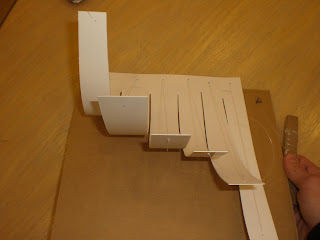
With the most recent foam mock-ups for our heliotropic smart surface, we are beginning the final stages of fabrication. We attempted a few different material uses but have settled on 1/4 inch plastic to be the base of our cellular region. We are choosing to embed the solar cell into the routed plastic and cover the conduits to achieve a polished an clean look for the entire surface. Johanna and I sat on digital project for much of last friday playing with a cellular structure that would not be completely uniform and each cell diameter would begin to gradient or shift in size. After much thought about this, we decided that in order to achieve the assemblage of a uniform field that we were looking for, we would need to create cells that are uniform in size. The motion was what we began to become engaged with, and it is one that requires a uniform cellular field that is modular. We want to create difference with motion between modular pieces rather than simply add variation with shapes. A unique motion in an unvaried field will be much more interesting and aesthetically appealing.


Our surface will be sitting about 3.5-4' off of the ground, which means it will require a frame. We have decided that our durable/shy solar cell aggregation will be encapsulated with a water jet cut steel frame. This gives a few members of the group a long awaited shot at using the water jet cutter and help expand our insistence on a cleanly fabricated surface. Another concern is the servo strength, and the hope that they can spin these cells and allow our surface to work without that terrible noise (ehh err ehh) that servos make when they try their hardest to spin. Jason just emailed the group to say that all of our stuff had arrived so I am incredibly excited to be back in Ann Arbor early tomorrow to check out the new toys.

Monday, November 9, 2009

32 days...


The final Project has been a difficult one to swallow. After early ideas of cigarette recepticals, we moved in and out of focus of the final heliotropic smart surface. Our team has sat down for hours upon hours discussing the implementation of our final design and the who what why where how- the instructors have had their input and thrown more than a few ideas aside, small cellular mock-ups have been made and we are well on our way. This past friday the meeting with the instructors has led me to question the actual endgame of this project. As always there is a delicate balance between the truly thought-out and conceptual integrity of our surface and the formal and detailed fabrication of the surface. Which should have priority because with 32 days left, I beleive that one might be left behind? What do I prefer-the beautiful and operational surface with shakey logic or the well-intentioned nearly-operational surface.
I think with three weeks almost down the drain, we now need to get into fabrication mode, our why might strengthen as we go on. Our surface is an example of biomimicry, in which we use a protective motion that resembles the manner in which the mimosa plant moves to avoid harm. All of the reserve held by the group members and lack of interest in this particular project seems to go away whenever something materializes into an object. This is why we need to focus on making this week rather than talking.

Monday, October 19, 2009

Post-Project


In the project before the final surface was assigned, our team (team 4) began the two week duration with some really fertile ideas during the brainstorming session. We all aligned on the premise that our surface would enable the use of natural sunlight without going through another medium-i.e. turning to battery power. Throughout the first week we met on 3 different occasions without building much, but the idea of a shading/light regulating device that would attach the the facade of the building seemed to interest the majority of group members.


One of the first decisions came with the movement of the device and it became something we knew was achievable with stepper/servo motors and also something that Z had found to be a very real and unique bimetallic strip that is currently being tested. Afraid of going to far without truly refining what it was this surface did, we hit a road block by trying to decipher the why. For two more meetings our group sat idle trying to figure out how this might interact with sunlight/skyscrapers/convection/city dwellers. After more inconclusiveness we decided to learn by making and created a pretty decent mockup.


As far as group work goes, the entire group came together during the end of the two weeks. The first week was incredibly different to get everyone together at once and each meeting our group was missing a few links, this caused periods of catching up during the next meetings. However in the end, everyone really sought to step up and help with something they had or had not done before. I was especially impressed at those who jumped at the chance to take digital project responsibilities without much training or previous knowledge. In the end we had built a surface that operated in the manner in which we thought the "real life" materials might respond if embedded into the facade of the building. We had talked quite a bit about the presentation and representation of the project, and hoped that interesting enough ideas would supplant our inability to gain access to bimetallic strips.

Julian Bleecker spoke very long about the production of things being a precursor to the discovery of purpose and usefulness. Team 3 was able utilize the Hoberman Sphere and created a very intricate two dimensional one but in the end admittedly found little purpose in their design-which in a sense was what Julian seemed to be articulating as his prime way of working. Our team seemed to work similarly in that we discovered this movement from a set of materials and immediately made it our project. Nearly half way through we hit a road block and all working and making stopped in order to find out why and attribute it to something that would be helpful. In the end I believe this period of stopping hurt us in the way that our surface was not nearly as refined or cleanly/interestingly executed as the other groups'. We could talk about it a bit more in application but I begin to wonder about the end result if the making had not stopped nearly half way through. If we had constructed multiple iterations and explored extremes of this set-up, might we have found a better and more logical application?

Thursday, October 8, 2009

MIT doing it big


A group of MIT Students have found a way to create sun-orienting solar cells with out the use of motors- thus increasing their efficiency. They used materials that replicated the heliotropic nature of plants that bent their pv cells towards the light.

http://dmse.mit.edu/madmec/helio.html

forcedgreen blog writes...
"They designed the system to imitate the way plants track the sun across the sky, by using the difference in temperature between shaded and sunny areas to change the properties of the material supporting solar photovoltaic cells. The system, once built, is completely passive, requiring no power source or electronics to control the movement. Solar cells that track the angle of the sun can be 38 percent more efficient at generating power than those that are mounted in a fixed position.
The team explored several different variations of the proposed system, using various materials including polymers and bimetallic strips. The system that shows the most promise, they said, mounts solar panels at the top of a curved arch made of a pair of metals such as aluminum and steel, which should be durable enough to withstand the elements with little or no maintenance.
The team demonstrated a scale model of the arch by shining a spotlight to warm up one side and cause the arch to bend, tilting the solar panel toward the light. They explained that the prototypes are cheaper than existing systems for tracking the sun and could be built from materials that are readily available in developing nations."

Sunday, October 4, 2009

Week 4


This week, our group of artists, architects, and engineers came together to build a pretty intuitive model. The focus of our model was a surface made up of a small mesh pattern who would open up and become more permeable with based on the intensity of sunlight. After a few nights of consideration and multiple ideas and mach-ups we had come to design of a three-serv0 hexagonal design that intended to be cellular and repeatable. The intention of the legs were to be twisted upwards in order to stretch the material and permitting sunlight to enter in order to power/store energy. The final model came out quite clean looking and well coded. We had tried a multitude of fabrics and materials and found that the legs could not stretch some or could not cause the desired effect with others, but the spandex seemed to have quite a bit of stretch while still remaining taut.
Nearly halfway through the week we were faced with the problem of how the code would work and if we had wanted to plot the sun position or if we wanted to use a real-time input. Our group opted for the input with the LDRs feeling that the weather might have quite a bit to do with how our surface would react and this may do a better job of harnessing sunlight.


The project relates directly to last week's heliotropic model. We were able to get this guy working using the standard code and 4 LDRs along with two pivoting servos. The group worked diligently during the hour we had for class but we had an incredibly difficult time honing in on the code and finding a suitable way to run these motors. The initial design had us using the LDRs as stationary elements, this method was later switched in favor of an easier and more concise set up in which the ldrs would be placed on the moving armature.

Tuesday, September 22, 2009

Arduino Groups


Friday we were split into new groups with the goal of creating a mechanism whose input is light and whose output is a motorized reaction. We were off to a quick start because we were told we only had about an hour. Our group quickly organized an idea that dealt with placing 3 LDR sensors on separated planes and using a servo to follow a flashlight which would be used to activate the LDRs. The Idea seemed simple enough and we divided jobs and got to work without the goal of perfection-rather just to get something working-in response to the multitude of failures last week.
We went about the coding by trying to patch together the two codes from earlier in the day and we had a difficult time getting this to work. A tip of where a single axis code was online came a little later and we tried to utilize this and add another axis. This took nearly the entire time and in the end, only one axis was working correctly. I noted stirrings from the rest of the group who talked after the project about how no one was on the same page and how the design was new to them-I agreed to an extent and perhaps those with the driving force behind the design should have illustrated it a bit better but really thought that this issue would have been addressed with a tad more time for the completion of the project.

Thursday, September 17, 2009

Arduino #1

The first color is blue, as I move my hand away the blinks become less rapid. When I reach a certain threshold (around 20 in), the color then turns to red and blinks even less rapidly. After the red (when my hand is around 5o inches away) the green light comes on a stays solid. I move my hand back quickly and the next reading lights up the blue again. The number of blinks are proportional to the distance away from my hand, which is also proportional to the number of readings the rangefinder takes. I was pretty happy with the result.


I had an old Rangefinder hanging around and I decided to put it to use with the lamp. I used a pretty simple piece of code that permitted three different lights to turn on with specific time lapses that were designated by the distance from the rangefinder. The Rangefinder definitely is not perfect but I got the results that I was looking for.


A Few Iterations of the my standard lamp...


I was able to get some laser time and made a small 3"x3"x3" lamp out of acrylic which was pretty easy to frost and to stuff with some trace to get the right look going.


I have had a bit of experience with arduino already, but the first couple of tutorials got me reacquainted.